
SHAKE IT UP
Project <Shake It Up> explores the imposed virtues of “obedience” and “submissiveness” assigned to women, and seeks to dismantle them through the body and the senses, opening up possibilities for agency and disobedience.
The project unfolds across multiple media, beginning with collage drawing and extending into sculpture, scent, soft sculpture, film, and performance.
Through this process, it challenges fixed hierarchies and social norms, questioning where internalised obedience originates and how it becomes embedded within women.
The hybrid monster emerges within this framework as a transcendent figure, symbolising freedom and disobedience while disrupting imposed systems and awakening the suppressed body.
This project was developed during the 2025–2026 MA programme at the Royal College of Art in the UK, evolving through interdisciplinary research and experimental practice.
It was also realised as part of a long-term collaborative programme between the Royal College of Art and International Flavors & Fragrances Inc. (IFF), and was selected as the winning project of the programme in 2026.
Project <Shake It Up> explores the imposed virtues of “obedience” and “submissiveness” assigned to women, and seeks to dismantle them through the body and the senses, opening up possibilities for agency and disobedience.
The project unfolds across multiple media, beginning with collage drawing and extending into sculpture, scent, soft sculpture, film, and performance.
Through this process, it challenges fixed hierarchies and social norms, questioning where internalised obedience originates and how it becomes embedded within women.
The hybrid monster emerges within this framework as a transcendent figure, symbolising freedom and disobedience while disrupting imposed systems and awakening the suppressed body.
This project was developed during the 2025–2026 MA programme at the Royal College of Art in the UK, evolving through interdisciplinary research and experimental practice.
It was also realised as part of a long-term collaborative programme between the Royal College of Art and International Flavors & Fragrances Inc. (IFF), and was selected as the winning project of the programme in 2026.
Medium
2D / 3D / SCENT / FILM / PERFORMANCE
Year
2025-2026


1. DRAWING COLLAGE
1-1 <Hybrid Monster>
The hybrid monster is a central figure within this project.
It symbolises freedom and disobedience, dismantling imposed norms and hierarchies and activating the suppressed body.
Historically, women have been compared to animals across many cultures, functioning as a means to regulate, degrade, and justify their subordination. At the same time, women who resisted these norms were labelled as monsters, witches, or abnormal.
This work brings these two structures together.
It fragments and recombines animal forms with images of the female body that have been objectified through a male gaze. Through collage, the body no longer functions as a fixed or stable meaning.
The resulting monster is not an object of fear, but a figure of excess, transformation, and vitality.
It rejects passivity and establishes the body as an active, unstable, and self-defining subject.
The monster incorporates the motif of vagina dentata, historically associated with male fear of female bodily power, and transforms it into a marker of reclaimed subjectivity.
The halo it wears does not represent traditional sanctity. It exposes how ‘sacredness’ has been constructed and destabilises its authority.
Within this collage drawing, the hybrid monster appears in the foreground as a three-dimensional form, set against the Sacred Power Portrait series as its background.
The dismantled images of authority are pushed out of the centre, and the monster takes their place. This structure collapses existing hierarchies and brings the body’s agency and subjectivity to the forefront.
The hybrid monster is a central figure within this project.
It symbolises freedom and disobedience, dismantling imposed norms and hierarchies and activating the suppressed body.
Historically, women have been compared to animals across many cultures, functioning as a means to regulate, degrade, and justify their subordination. At the same time, women who resisted these norms were labelled as monsters, witches, or abnormal.
This work brings these two structures together.
It fragments and recombines animal forms with images of the female body that have been objectified through a male gaze. Through collage, the body no longer functions as a fixed or stable meaning.
The resulting monster is not an object of fear, but a figure of excess, transformation, and vitality.
It rejects passivity and establishes the body as an active, unstable, and self-defining subject.
The monster incorporates the motif of vagina dentata, historically associated with male fear of female bodily power, and transforms it into a marker of reclaimed subjectivity.
The halo it wears does not represent traditional sanctity. It exposes how ‘sacredness’ has been constructed and destabilises its authority.
Within this collage drawing, the hybrid monster appears in the foreground as a three-dimensional form, set against the Sacred Power Portrait series as its background.
The dismantled images of authority are pushed out of the centre, and the monster takes their place. This structure collapses existing hierarchies and brings the body’s agency and subjectivity to the forefront.
Medium
2D-Drawing, Collage
Year
2025

<Hybrid Monster_1> / Mixed media / 2025 / 394 x 290mm
<Hybrid Monster_1> / Mixed media / 2025 / 394 x 290mm
<Hybrid Monster_1> / Mixed media / 2025 / 394 x 290mm

<Hybrid Monster_2> / Mixed media / 2025 / 400 x 281mm
<Hybrid Monster_2> / Mixed media / 2025 / 400 x 281mm
<Hybrid Monster_2> / Mixed media / 2025 / 400 x 281mm

<Hybrid Monster_3> / Mixed media / 2025 / 434 x 400mm
<Hybrid Monster_3> / Mixed media / 2025 / 434 x 400mm
<Hybrid Monster_3> / Mixed media / 2025 / 434 x 400mm
1. DRAWING COLLAGE
1-2 <Sacred Power Portrait>
This collage work functions as a background layer for the hybrid monster.
It focuses on patriarchy and iconoclasm, questioning, weakening, and dismantling the historical, religious, and political structures that have constructed and reinforced obedience as a virtue.
The artist collects portraits of figures positioned at the top of patriarchal hierarchies, including Western saints, kings, and military figures, as well as Korean monarchs and modern presidents.
These images, once invested with meaning, are physically dismantled through processes of soaking, tearing, and damage, resembling posters ripped from walls where their authority has already faded.
Through collage, the reassembled images are stripped of human identity and no longer reproduce sacred hierarchies.
Instead, they remain as fragmented, abstract patterns that function as residual traces of power.
This visual structure weakens the centre of power and prevents it from operating as something fixed or absolute.
Authority is pushed into the background and no longer functions as a dominant framework.
This displacement establishes the conditions for a new subject to emerge.
As power recedes, the hybrid monster appears in the foreground, replacing the existing hierarchy.
This collage work functions as a background layer for the hybrid monster.
It focuses on patriarchy and iconoclasm, questioning, weakening, and dismantling the historical, religious, and political structures that have constructed and reinforced obedience as a virtue.
The artist collects portraits of figures positioned at the top of patriarchal hierarchies, including Western saints, kings, and military figures, as well as Korean monarchs and modern presidents.
These images, once invested with meaning, are physically dismantled through processes of soaking, tearing, and damage, resembling posters ripped from walls where their authority has already faded.
Through collage, the reassembled images are stripped of human identity and no longer reproduce sacred hierarchies.
Instead, they remain as fragmented, abstract patterns that function as residual traces of power.
This visual structure weakens the centre of power and prevents it from operating as something fixed or absolute.
Authority is pushed into the background and no longer functions as a dominant framework.
This displacement establishes the conditions for a new subject to emerge.
As power recedes, the hybrid monster appears in the foreground, replacing the existing hierarchy.
Medium
2D-Drawing, Collage
Year
2025

<Sacred Power Portrait_1> / Mixed media / 2026 / 460 x 345mm
<Sacred Power Portrait_1> / Mixed media / 2026 / 460 x 345mm
<Sacred Power Portrait_1> / Mixed media / 2026 /
460 x 345mm
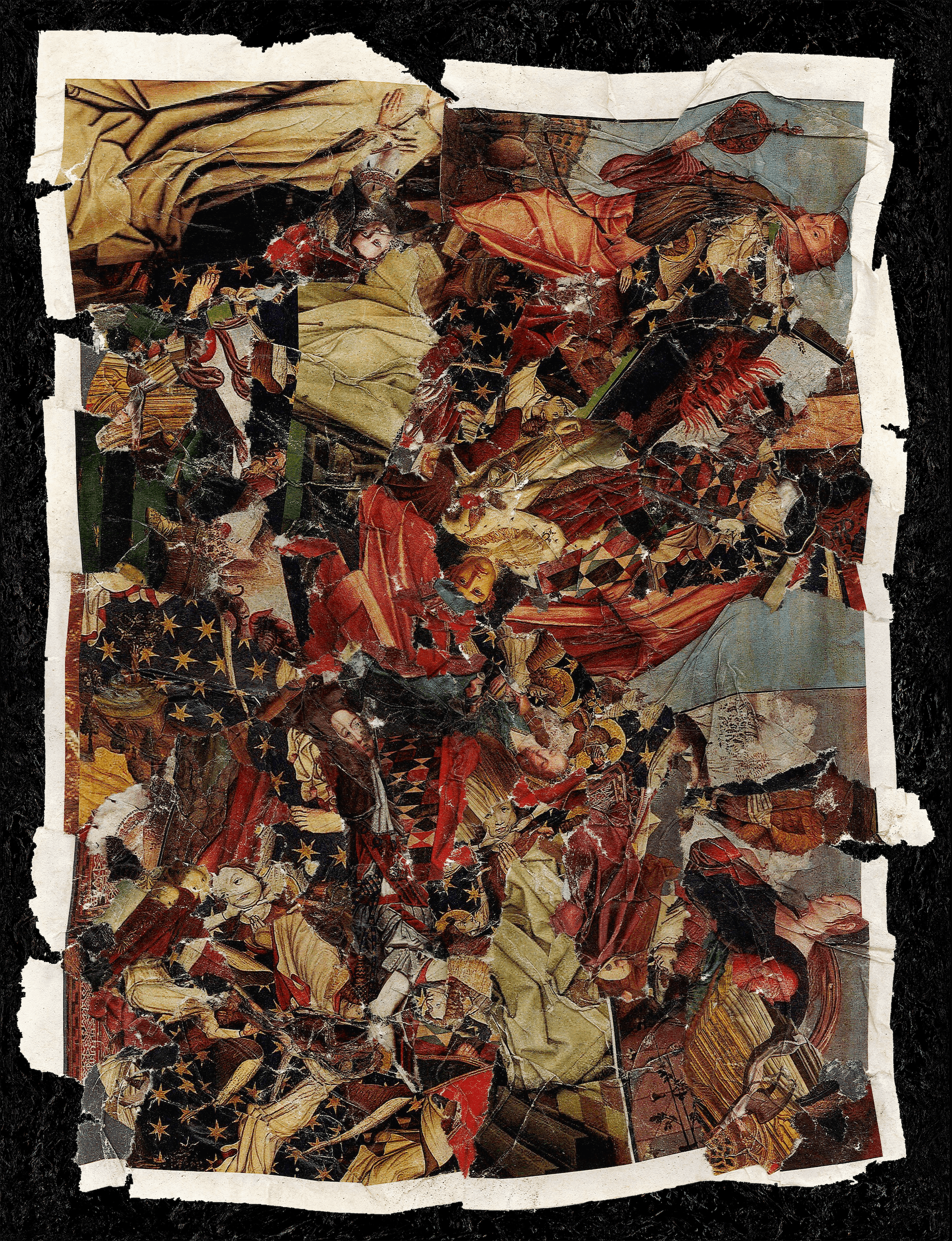
<Sacred Power Portrait_2> / Mixed media / 2026 / 391 x 300mm
<Sacred Power Portrait_2> / Mixed media / 2026 / 391 x 300mm
<Sacred Power Portrait_2> / Mixed media / 2026 /
391 x 300mm

<Sacred Power Portrait_3> / Mixed media / 2026 / 425 x 290mm
<Sacred Power Portrait_3> / Mixed media / 2026 / 425 x 290mm
<Sacred Power Portrait_3> / Mixed media / 2026 /
425 x 290mm

<Sacred Power Portrait_4> / Mixed media / 2026 / 425 x 287mm
<Sacred Power Portrait_4> / Mixed media / 2026 / 425 x 287mm
<Sacred Power Portrait_4> / Mixed media / 2026 /
425 x 287mm

<Sacred Power Portrait_5> / Mixed media / 2026 / 425 x 300mm
<Sacred Power Portrait_5> / Mixed media / 2026 / 425 x 300mm
<Sacred Power Portrait_5> / Mixed media / 2026 /
425 x 300mm

<Sacred Power Portrait_6> / Mixed media / 2026 / 425 x 300mm
<Sacred Power Portrait_6> / Mixed media / 2026 / 425 x 300mm
<Sacred Power Portrait_6> / Mixed media / 2026 /
425 x 300mm
1. DRAWING COLLAGE
1-3 <Material Richness>
This work develops the black painted texture, originally used as a background for the hybrid monster and the Sacred Power Portrait, into an independent painting.
It is no longer a supporting element, but establishes its own autonomous structure of meaning.
Within the drawing–collage series, a dismantled image of the Sacred Power Portrait is placed behind the hybrid monster, while the surrounding black texture forms another layer of background.
This black surface imitates the painterly texture typically produced by thick layers of paint.
However, it is not built through accumulated acrylic. Instead, the surface is constructed using paper towels soaked in water and glue, then coated with black acrylic paint.
This method deliberately mimics the painterly gesture associated with material richness and authority, while replacing its foundation with fragile, everyday materials.
It operates as a form of visual deception.
Through this strategy, it subverts the hierarchy produced by material and surface in painting, particularly the authority associated with expensive materials.
Within this series, the black texture functions as the background to the dismantled Sacred Power Portrait.
While it imitates the visual grandeur that surrounds images of authority, it simultaneously exposes its hidden material basis, weakening and undermining the form of power.
The portrait of the hybrid monster is placed on top of these two layers. This does not simply replace or reoccupy the conventional format of authoritative portraiture with a different subject, but destabilises and restructures the system itself.
The black texture also expands into an independent body of painting. By bringing a background element to the foreground, it mimics and distorts the visual language of authority while exposing its material foundation.
This work develops the black painted texture, originally used as a background for the hybrid monster and the Sacred Power Portrait, into an independent painting.
It is no longer a supporting element, but establishes its own autonomous structure of meaning.
Within the drawing–collage series, a dismantled image of the Sacred Power Portrait is placed behind the hybrid monster, while the surrounding black texture forms another layer of background.
This black surface imitates the painterly texture typically produced by thick layers of paint.
However, it is not built through accumulated acrylic. Instead, the surface is constructed using paper towels soaked in water and glue, then coated with black acrylic paint.
This method deliberately mimics the painterly gesture associated with material richness and authority, while replacing its foundation with fragile, everyday materials. It operates as a form of visual deception.
Through this strategy, it subverts the hierarchy produced by material and surface in painting, particularly the authority associated with expensive materials.
Within this series, the black texture functions as the background to the dismantled Sacred Power Portrait.
While it imitates the visual grandeur that surrounds images of authority, it simultaneously exposes its hidden material basis, weakening and undermining the form of power.
The portrait of the hybrid monster is placed on top of these two layers. This does not simply replace or reoccupy the conventional format of authoritative portraiture with a different subject, but destabilises and restructures the system itself.
The black texture also expands into an independent body of painting. By bringing a background element to the foreground, it mimics and distorts the visual language of authority while exposing its material foundation.
This work develops the black painted texture, originally used as a background for the hybrid monster and the Sacred Power Portrait, into an independent painting.
It is no longer a supporting element, but establishes its own autonomous structure of meaning.
Within the drawing–collage series, a dismantled image of the Sacred Power Portrait is placed behind the hybrid monster, while the surrounding black texture forms another layer of background.
This black surface imitates the painterly texture typically produced by thick layers of paint.
However, it is not built through accumulated acrylic. Instead, the surface is constructed using paper towels soaked in water and glue, then coated with black acrylic paint.
This method deliberately mimics the painterly gesture associated with material richness and authority, while replacing its foundation with fragile, everyday materials.
It operates as a form of visual deception.
Through this strategy, it subverts the hierarchy produced by material and surface in painting, particularly the authority associated with expensive materials.
Within this series, the black texture functions as the background to the dismantled Sacred Power Portrait.
While it imitates the visual grandeur that surrounds images of authority, it simultaneously exposes its hidden material basis, weakening and undermining the form of power.
The portrait of the hybrid monster is placed on top of these two layers. This does not simply replace or reoccupy the conventional format of authoritative portraiture with a different subject, but destabilises and restructures the system itself.
The black texture also expands into an independent body of painting. By bringing a background element to the foreground, it mimics and distorts the visual language of authority while exposing its material foundation.
Medium
2D-Drawing, Collage
Year
2025

<Material Richness> / Acrylic, paper towel, glue on canvas / 2026 / 600 x 400mm
<Material Richness> / Acrylic, paper towel, glue on canvas / 2026
/ 600 x 400mm
<Material Richness> / Acrylic, paper towel, glue on canvas / 2026 / 600 x 400mm
1. DRAWING COLLAGE
1-4 <The Elevated Sacred Power Portrait>
This work extends the Sacred Power Portrait series through a different approach.
While earlier works engaged with images of Western kings, saints, and military figures, this series focuses on Korean monarchs and presidents.
Rather than using existing portraits directly, it employs AI-generated images as its primary material.
AI produces images rapidly and in large quantities, often resulting in forms that appear exaggerated, shallow, and at times crude.
This work places these qualities at its centre. Through repeated attempts to intensify and amplify authority, the image does not stabilise or strengthen, but instead begins to collapse.
An image of a president was uploaded into an AI system, followed by the prompt: “depict this figure as an extremely great, respected, and authoritative king,” with the command “more powerful, more respected” repeated multiple times.
As the process continues, the image becomes increasingly inflated and excessive, transforming not into a sacred or dignified portrait, but into something staged and vulgar.
This reveals an irony in which the attempt to absolutise authority ultimately renders it absurd.
The same process was then applied in Midjourney, where the generation process is made visible.
The transformations that emerge appear unstable and grotesque. In this work, AI does not function as a neutral image-making tool, but as a device that distorts and exposes how authority is constructed and amplified.
Because these figures are tied to histories of power and violence, their distortion reveals these conditions more directly.
The generated images are then treated like torn posters—soaked, ripped, and physically damaged.
Stripped of identity and reduced to abstract traces, they are reassembled into large-scale collages.
These collages are not presented as a single canvas, but divided across two panels.
While they mimic the scale and authority of monumental painting, they remain fragmented and mobile.
As a result, the work partially adopts the format of authoritative portraiture, while ultimately dismantling it through division and reconstruction.
This work extends the Sacred Power Portrait series through a different approach.
While earlier works engaged with images of Western kings, saints, and military figures, this series focuses on Korean monarchs and presidents. Rather than using existing portraits directly, it employs AI-generated images as its primary material.
AI produces images rapidly and in large quantities, often resulting in forms that appear exaggerated, shallow, and at times crude. This work places these qualities at its centre. Through repeated attempts to intensify and amplify authority, the image does not stabilise or strengthen, but instead begins to collapse.
An image of a president was uploaded into an AI system, followed by the prompt: “depict this figure as an extremely great, respected, and authoritative king,” with the command “more powerful, more respected” repeated multiple times.
As the process continues, the image becomes increasingly inflated and excessive, transforming not into a sacred or dignified portrait, but into something staged and vulgar. This reveals an irony in which the attempt to absolutise authority ultimately renders it absurd.
The same process was then applied in Midjourney, where the generation process is made visible. The transformations that emerge appear unstable and grotesque. In this work, AI does not function as a neutral image-making tool, but as a device that distorts and exposes how authority is constructed and amplified.
Because these figures are tied to histories of power and violence, their distortion reveals these conditions more directly.
The generated images are then treated like torn posters—soaked, ripped, and physically damaged. Stripped of identity and reduced to abstract traces, they are reassembled into large-scale collages.
These collages are not presented as a single canvas, but divided across two panels.
While they mimic the scale and authority of monumental painting, they remain fragmented and mobile.
As a result, the work partially adopts the format of authoritative portraiture, while ultimately dismantling it through division and reconstruction.
Medium
2D-Drawing, Collage
Year
2026

<The Elevated Sacred Power Portrait> / Mixed media / 2026 / 1200 x 900mm
<The Elevated Sacred Power Portrait> / Mixed media / 2026
/ 1200 x 900mm
<The Elevated Sacred Power Portrait> / Mixed media / 2026 / 1200 x 900mm
.


.
.


.

2. SCENT
This project was developed as a collaboration between the Royal College of Art and International Flavors & Fragrances(IFF), working with IFF perfumer Kailey.
The artist proposed the concept, and the perfumer realised it through raw materials to produce the final fragrance.
Scent extends in this project as another medium and operates as a tool to disrupt norms and hierarchies.
As a fluid and historically undervalued sense, it functions as an effective medium for unsettling established orders.
This work revisits animals that have been used to control and demean women. Unlike humans, animals use scent actively for survival, defence, and sexual power.
From this perspective, scent is not a passive ornament, but a means of expressing agency. Animalic and at times uncomfortable elements act as forces that overturn repression, forming a complex structure when combined with softer notes.
The concept is realised through two separate layers. Inside the bottle, water and oil remain divided, representing “obedience and beauty” and “disobedience and animal freedom.”
The “obedience” scent presents a soft, controlled, and composed character, structured around a floral base.
In contrast, the “disobedience” scent is raw and animalic, foregrounding force and resistance as something that returns to the body.
The scent is completed through the act of shaking.
When shaken, the two layers mix, producing a new colour and scent that holds both qualities simultaneously.
The act of shaking functions not only as use, but as a performance and a ritual. It breaks a fixed state and moves toward a condition where contrasting elements coexist, symbolising the reclamation of the body and identity beyond enforced obedience.
Through repeated mixing and separation, the perfume reveals not a fixed identity, but a continuous state of transformation.
This project was developed as a collaboration between the Royal College of Art and International Flavors & Fragrances(IFF), working with IFF perfumer Kailey.
The artist proposed the concept, and the perfumer realised it through raw materials to produce the final fragrance.
Scent extends in this project as another medium and operates as a tool to disrupt norms and hierarchies.
As a fluid and historically undervalued sense, it functions as an effective medium for unsettling established orders.
This work revisits animals that have been used to control and demean women. Unlike humans, animals use scent actively for survival, defence, and sexual power.
From this perspective, scent is not a passive ornament, but a means of expressing agency. Animalic and at times uncomfortable elements act as forces that overturn repression, forming a complex structure when combined with softer notes.
The concept is realised through two separate layers. Inside the bottle, water and oil remain divided, representing “obedience and beauty” and “disobedience and animal freedom.”
The “obedience” scent presents a soft, controlled, and composed character, structured around a floral base.
In contrast, the “disobedience” scent is raw and animalic, foregrounding force and resistance as something that returns to the body.
The scent is completed through the act of shaking. When shaken, the two layers mix, producing a new colour and scent that holds both qualities simultaneously.
The act of shaking functions not only as use, but as a performance and a ritual. It breaks a fixed state and moves toward a condition where contrasting elements coexist, symbolising the reclamation of the body and identity beyond enforced obedience.
Through repeated mixing and separation, the perfume reveals not a fixed identity, but a continuous state of transformation.
This project was developed as a collaboration between the Royal College of Art and International Flavors & Fragrances(IFF), working with IFF perfumer Kailey. The artist proposed the concept, and the perfumer realised it through raw materials to produce the final fragrance.
Scent extends in this project as another medium and operates as a tool to disrupt norms and hierarchies.
As a fluid and historically undervalued sense, it functions as an effective medium for unsettling established orders.
This work revisits animals that have been used to control and demean women. Unlike humans, animals use scent actively for survival, defence, and sexual power.
From this perspective, scent is not a passive ornament, but a means of expressing agency. Animalic and at times uncomfortable elements act as forces that overturn repression, forming a complex structure when combined with softer notes.
The concept is realised through two separate layers. Inside the bottle, water and oil remain divided, representing “obedience and beauty” and “disobedience and animal freedom.”
The “obedience” scent presents a soft, controlled, and composed character, structured around a floral base.
In contrast, the “disobedience” scent is raw and animalic, foregrounding force and resistance as something that returns to the body.
The scent is completed through the act of shaking. When shaken, the two layers mix, producing a new colour and scent that holds both qualities simultaneously.
The act of shaking functions not only as use, but as a performance and a ritual. It breaks a fixed state and moves toward a condition where contrasting elements coexist, symbolising the reclamation of the body and identity beyond enforced obedience.
Through repeated mixing and separation, the perfume reveals not a fixed identity, but a continuous state of transformation.
Medium
Scent
Year
2026

.

3. OBjECT
3-1 <Dual State Vessel>
This scent work extends into a material form through the bottle.
The perfume bottle is not simply a container, but is designed as a sculptural object.
It is structured to hold two separate layers and takes form through the act of shaking. Inside, water and oil remain separated, representing “gentleness and beauty” and “disobedience and animalistic freedom.”
The form of the bottle visually expresses this duality. Two faces joined vertically embody different states simultaneously: one presents an idealised face of beauty, while the other takes the form of a monstrous face.
These two faces coexist within a single structure without being separated, suggesting that opposing states can exist at the same time.
When the bottle is shaken, the two layers inside mix, transforming in colour and scent.
The act of shaking is not simply a way of using the bottle, but a gesture, a performance, and a ritual that breaks a fixed state and generates change.
This scent work extends into a material form through the bottle.
The perfume bottle is not simply a container, but is designed as a sculptural object.
It is structured to hold two separate layers and takes form through the act of shaking. Inside, water and oil remain separated, representing “gentleness and beauty” and “disobedience and animalistic freedom.”
The form of the bottle visually expresses this duality. Two faces joined vertically embody different states simultaneously: one presents an idealised face of beauty, while the other takes the form of a monstrous face.
These two faces coexist within a single structure without being separated, suggesting that opposing states can exist at the same time.
When the bottle is shaken, the two layers inside mix, transforming in colour and scent.
The act of shaking is not simply a way of using the bottle, but a gesture, a performance, and a ritual that breaks a fixed state and generates change.
Medium
3D - Object, Sculpture
Year
2026

<Dual State Vessel> / Mixed media / 2026 / 00 x 00mm
<Dual State Vessel> / Mixed media / 2026 / 00 x 00mm
3. OBjECT
3-2 < Scent Altar Structure>
A box for the bottle is also designed.
This structure is not simply a storage device, but is constructed to be hung on the wall and displayed, extending the bottle into an object within space.
At the same time, it transforms scent as an immaterial medium into a three-dimensional installation reminiscent of an altar.
Through this, the bottle operates beyond a functional object, becoming a sculptural work in which bodily action, space, and sensory experience are brought together.
A box for the bottle is also designed.
This structure is not simply a storage device, but is constructed to be hung on the wall and displayed, extending the bottle into an object within space.
At the same time, it transforms scent as an immaterial medium into a three-dimensional installation reminiscent of an altar.
Through this, the bottle operates beyond a functional object, becoming a sculptural work in which bodily action, space, and sensory experience are brought together.
Medium
3D - Object, Sculpture
Year
2025
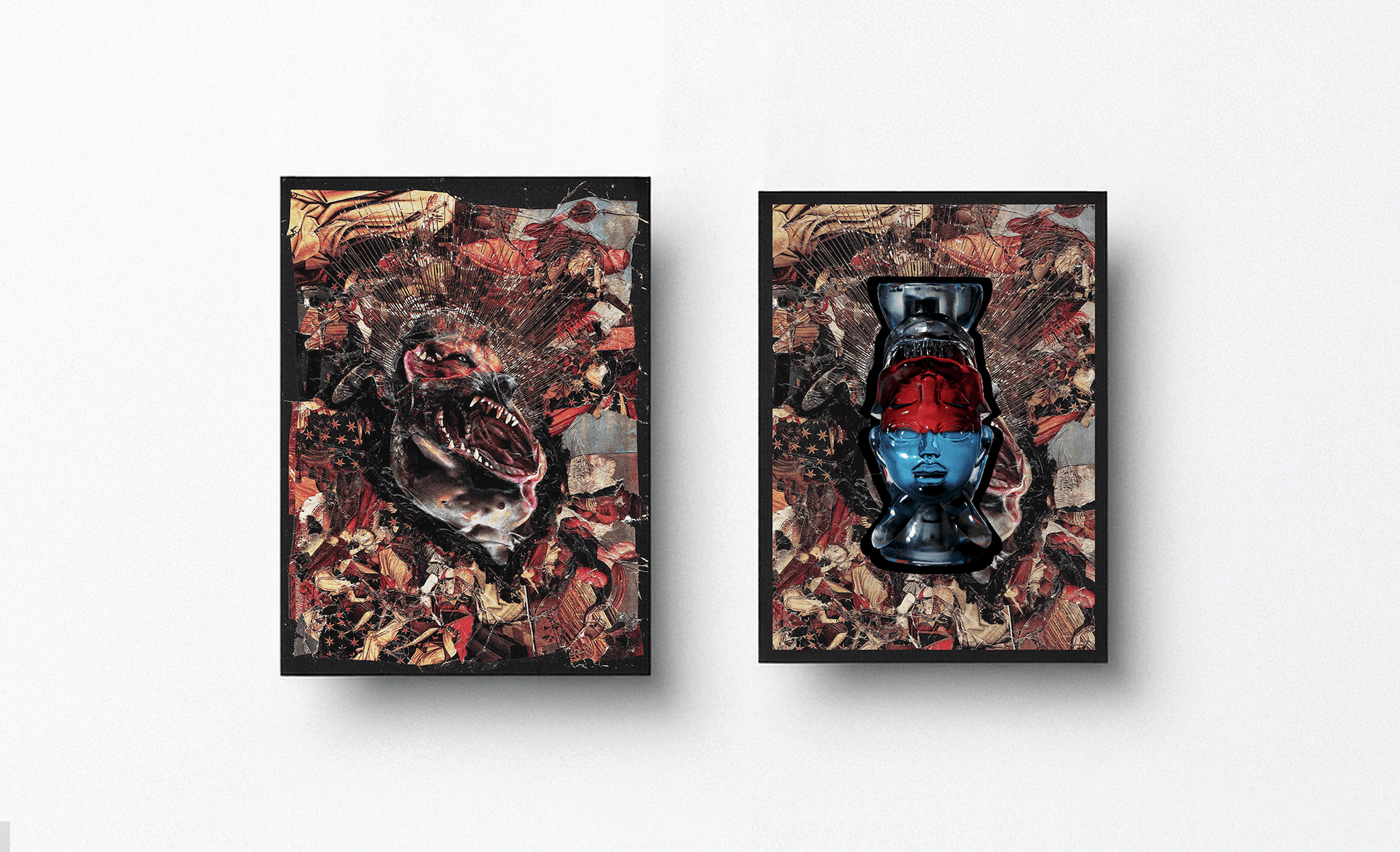
<Scent Altar Structure> / Mixed media / 2025 / 00 x 00mm
<Scent Altar Structure> / Mixed media / 2025 / 00 x 00mm
<Scent Altar Structure> / Mixed media / 2025 /
00 x 00mm


4. Fabrication
This fabric development begins as an attempt to extend the project’s central concept of the “hybrid monster” beyond drawing and collage into a fully three-dimensional form.
In this process, the artist develops the fabric by drawing on the forms and textures of human and animal organs observed at the Hunterian Museum. These observations lead to an understanding that unfamiliar and heterogeneous forms exist within all bodies.
These internal forms, rather than being defined as monstrosity and excluded, are understood as an unfamiliar visual condition.
The artist translates this understanding into fabric, transforming the ‘monstrosity’ within the body into an external visual structure.
This fabric development begins as an attempt to extend the project’s central concept of the “hybrid monster” beyond drawing and collage into a fully three-dimensional form.
In this process, the artist develops the fabric by drawing on the forms and textures of human and animal organs observed at the Hunterian Museum. These observations lead to an understanding that unfamiliar and heterogeneous forms exist within all bodies.
These internal forms, rather than being defined as monstrosity and excluded, are understood as an unfamiliar visual condition.
The artist translates this understanding into fabric, transforming the ‘monstrosity’ within the body into an external visual structure.
Medium
3D - Fabrication, Fashion
Year
2025

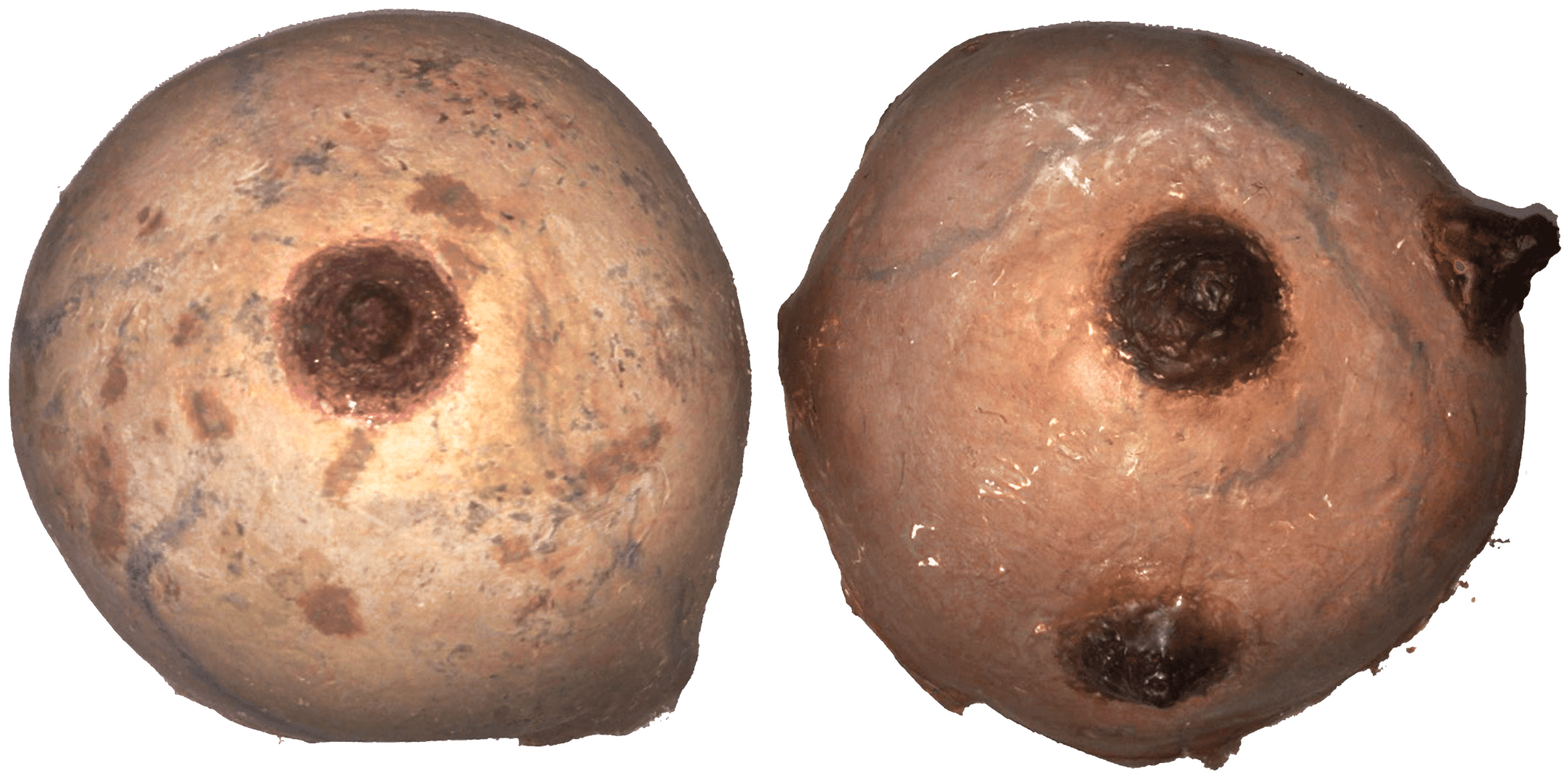

<Fabrication> / Mixed media / 2025
<Fabrication> / Mixed media / 2025


5. soft SCULPTURE
Building on this fabric development, the hybrid monster is realised as a fully three-dimensional wearable soft sculpture. Rather than a fixed object for viewing, it is designed to be worn on the body and activated through movement.
In this project, stillness signifies obedience and oppression, while movement represents disobedience and action. The soft sculpture does not exist as a completed form, but emerges and shifts through the movement of the body.
The initial drawings function as planning sketches for this transition, leading to a sculptural structure that merges with the body.
The soft sculpture combines distorted and fragmented forms of animal and female bodies. This hybrid structure produces a grotesque yet comic presence.
By combining and exaggerating figures that have historically been subject to stigma and ridicule, the work transforms the body into an unfamiliar and excessive visual language. In doing so, it creates a tension between discomfort and attraction, unsettling fixed perceptions of the body.
The monster incorporates the motif of vagina dentata, presenting the body in a direct and explicit manner. This approach amplifies the suppressed force of the body through an excessive form.
Small bells are attached to the monster, each carrying a drop of either the obedience or disobedience scent. As the body moves, the bells produce sound while the scent disperses into the air and mixes again.
In this way, movement extends beyond visual form into a multi-sensory experience that includes scent and sound. The hybrid monster operates as a structure that is completed through the body, the senses, and action.
Building on this fabric development, the hybrid monster is realised as a fully three-dimensional wearable soft sculpture. Rather than a fixed object for viewing, it is designed to be worn on the body and activated through movement.
In this project, stillness signifies obedience and oppression, while movement represents disobedience and action. The soft sculpture does not exist as a completed form, but emerges and shifts through the movement of the body.
The initial drawings function as planning sketches for this transition, leading to a sculptural structure that merges with the body.
The soft sculpture combines distorted and fragmented forms of animal and female bodies. This hybrid structure produces a grotesque yet comic presence.
By combining and exaggerating figures that have historically been subject to stigma and ridicule, the work transforms the body into an unfamiliar and excessive visual language. In doing so, it creates a tension between discomfort and attraction, unsettling fixed perceptions of the body.
The monster incorporates the motif of vagina dentata, presenting the body in a direct and explicit manner. This approach amplifies the suppressed force of the body through an excessive form.
Small bells are attached to the monster, each carrying a drop of either the obedience or disobedience scent. As the body moves, the bells produce sound while the scent disperses into the air and mixes again.
In this way, movement extends beyond visual form into a multi-sensory experience that includes scent and sound. The hybrid monster operates as a structure that is completed through the body, the senses, and action.
Medium
3D - Fabrication, Fashion, Soft Sculpture
Year
2026

<Hybrid Monster> / Watercolour on paper with digital elements / 2025 / 341 x 429mm
<Hybrid Monster> / Watercolour on paper with digital elements / 2025 / 341 x 429mm

<Hybrid Monster> / Mixed media / 2026 / 1580 x 650 x 450mm
<Hybrid Monster> / Mixed media / 2026 / 1580 x 650 x 450mm
<Hybrid Monster> / Mixed media / 2026 /
1580 x 650 x 450mm
6. PUPPET
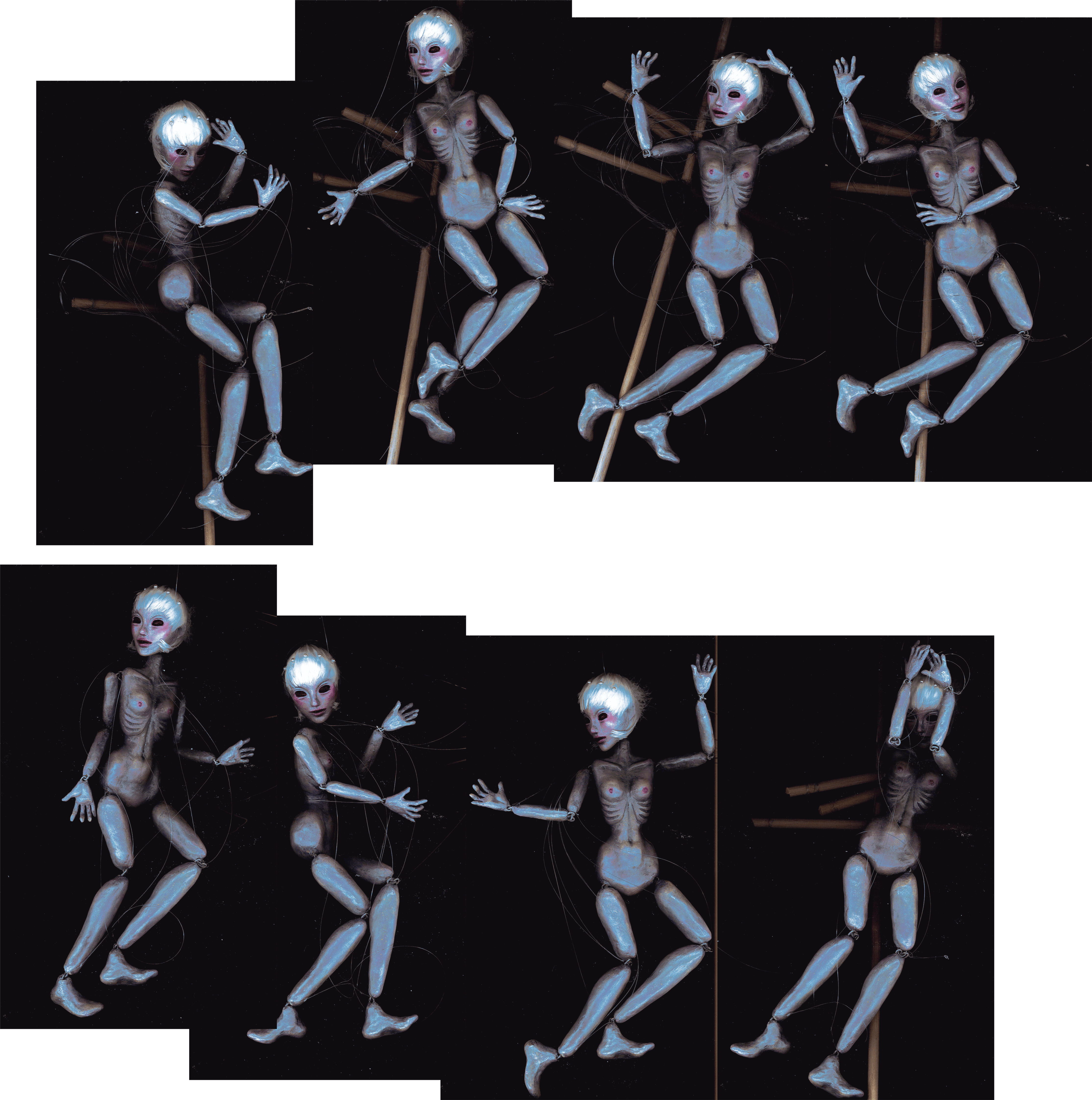
In this work, the puppet presents a body that stands in contrast to the hybrid monster. The puppet is a static body controlled by external forces, while the hybrid monster is an active form that is shaped through its own movement.
The puppet operates through external force, representing a body that has been stripped of autonomy. It embodies a state in which imposed obedience is fixed onto the body.
Even when movement is introduced, the puppet’s body is not self-generated, but limited to actions dictated by external control. Once the movement ceases, it returns to a rigid state of stillness.
While the puppet maintains an outward appearance of beauty, it is at the same time a distorted and lifeless body.
In this work, the puppet presents a body that stands in contrast to the hybrid monster. The puppet is a static body controlled by external forces, while the hybrid monster is an active form that is shaped through its own movement.
The puppet operates through external force, representing a body that has been stripped of autonomy. It embodies a state in which imposed obedience is fixed onto the body.
Even when movement is introduced, the puppet’s body is not self-generated, but limited to actions dictated by external control. Once the movement ceases, it returns to a rigid state of stillness.
While the puppet maintains an outward appearance of beauty, it is at the same time a distorted and lifeless body.
Medium
3D - Object, Sculpture, Puppet, Set
Year
2026

.

<Puppetry of Obedience> / Mixed media / 2026 / 1520 x 1020 x 630mm
<Puppetry of Obedience> / Mixed media / 2026 / 1520 x 1020 x 630mm
<Puppetry of Obedience> / Mixed media / 2026 /
1520 x 1020 x 630mm
<Puppet-Obedience> / Mixed media / 2026 / 435 x 100mm
<Puppet-Obedience> / Mixed media / 2026 / 435 x 100mm
7. film
To make the contrast between the soft sculpture and the puppet explicit, the work extends into film.
The film begins with the puppet’s body. The puppet moves through external force and remains in a controlled state. It performs gestures that suggest seduction, hesitation, and desire, yet these movements are not self-generated but remain limited actions imposed from outside.
Within this structure, scent acts as a catalyst for transformation. In the film, scent is rendered visually through red and blue liquid and light. This element disrupts the suppressed state of the puppet and initiates a shift in its condition.
Through this process, the puppet’s body transforms into the hybrid monster, and the nature of its movement changes. The restricted gestures imposed from outside disappear, and the body shifts into movements of disobedience formed from within.
These movements are shaped by music and choreography inspired by Gut, a Korean shamanic ritual. Gut involves practices historically regarded as abnormal or marginal, and this context aligns with the work’s exploration of the boundary between norm and disobedience.
The film is structured around the contrast between movements of obedience and movements of disobedience, using the body to expose and shift the boundary between the normal and the abnormal.
Through its expansion across different media, the project examines and challenges the structures of control and regulation inscribed onto the body.
To make the contrast between the soft sculpture and the puppet explicit, the work extends into film.
The film begins with the puppet’s body. The puppet moves through external force and remains in a controlled state. It performs gestures that suggest seduction, hesitation, and desire, yet these movements are not self-generated but remain limited actions imposed from outside.
Within this structure, scent acts as a catalyst for transformation. In the film, scent is rendered visually through red and blue liquid and light. This element disrupts the suppressed state of the puppet and initiates a shift in its condition.
Through this process, the puppet’s body transforms into the hybrid monster, and the nature of its movement changes. The restricted gestures imposed from outside disappear, and the body shifts into movements of disobedience formed from within.
These movements are shaped by music and choreography inspired by Gut, a Korean shamanic ritual. Gut involves practices historically regarded as abnormal or marginal, and this context aligns with the work’s exploration of the boundary between norm and disobedience.
The film is structured around the contrast between movements of obedience and movements of disobedience, using the body to expose and shift the boundary between the normal and the abnormal.
Through its expansion across different media, the project examines and challenges the structures of control and regulation inscribed onto the body.
Medium
Film, Performance
Year
2026


.
.